Toxic Family: Should You Cut Them Off or Do the Work?
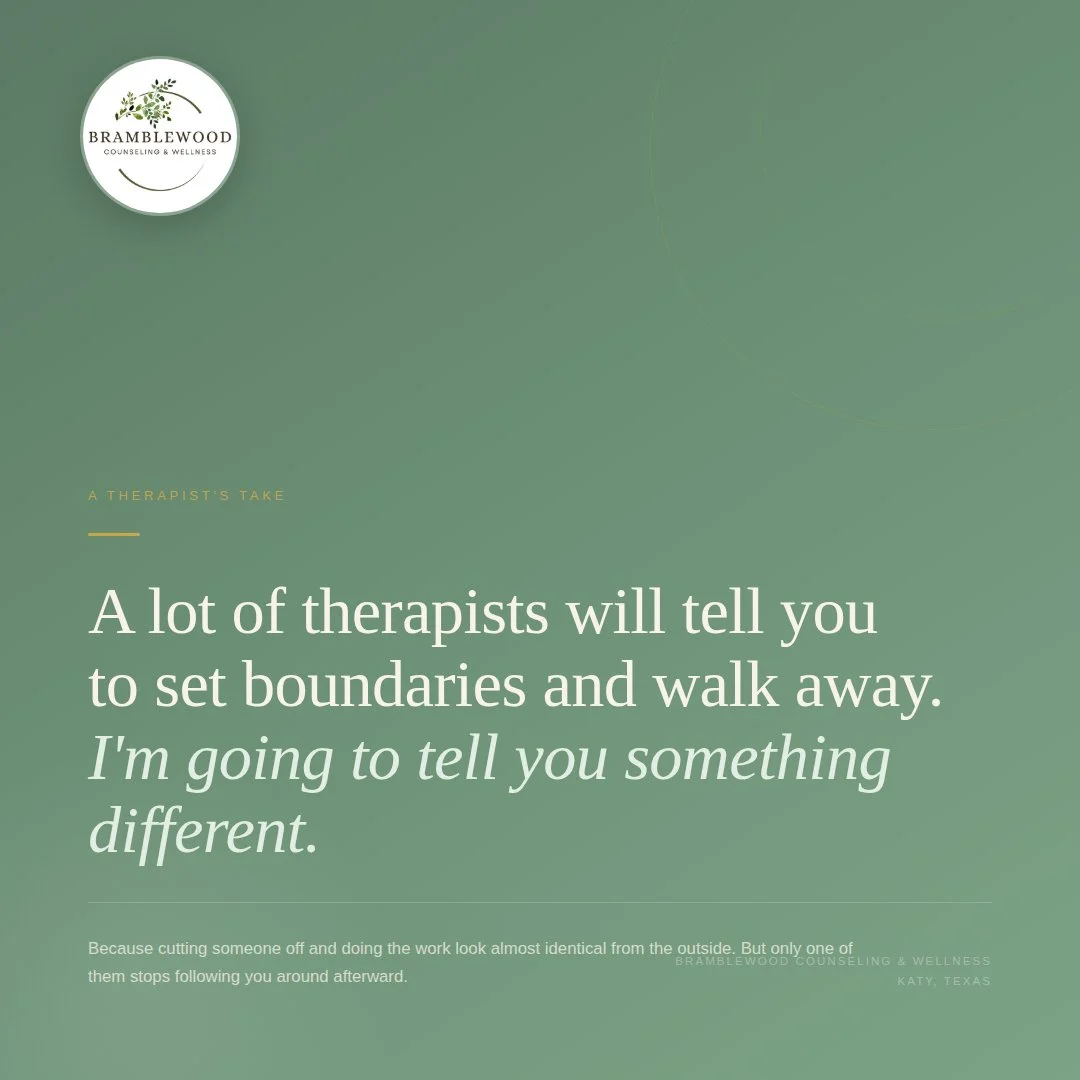
Toxic Family Work
Toxic Family: Should You Cut Them Off or Do the Work?
A therapist in Katy, Texas shares what to consider when navigating difficult family relationships
Most of us have someone. A person we love and also find hard to love. Someone whose name on our phone makes us pause before answering. A relationship that lives in that complicated space between history and hurt.
If you’re here, you’re probably trying to figure out what to do with that relationship. Stay? Set boundaries? Create distance? Or walk away completely?
There’s a lot of advice out there right now about “cutting off toxic family members.” And while that can be the right choice in some situations, it’s not always the only answer. Not every difficult relationship is beyond repair, and not every painful dynamic requires complete disconnection.
Sometimes what you actually need is clarity. Not a script. Not a quick answer. Just a clear, honest understanding of what you want and what’s possible.
That’s what this conversation is about.
What “Toxic Family” Actually Means
The word toxic gets used a lot, and sometimes it’s used to describe relationships that are simply uncomfortable, different, or emotionally complicated.
But a truly harmful family dynamic usually involves patterns like:
Ongoing disrespect
Manipulation or guilt
Emotional neglect or unavailability
Feeling consistently unseen, unsafe, or “less than”
It’s not one bad interaction. It’s a pattern that repeats and leaves a lasting impact.
Understanding the difference matters, because the path forward depends on what you’re actually dealing with.
The Better Question to Ask
Instead of asking, “Should I cut them off?” a more helpful question is:
“Am I avoiding this, or am I growing through it?”
Avoidance often looks like:
Leaving before you’ve said what needs to be said
Deciding it’s hopeless without trying something different
Confusing discomfort with danger
Growth looks like:
Having honest conversations, even when they’re hard
Setting boundaries and seeing what happens next
Making a clear, grounded decision about what you can and cannot accept
Both paths can create distance. But only one tends to bring peace.
What Boundaries Actually Look Like
Boundaries are not punishment. They are not walls.
They are the conditions that allow you to stay in a relationship without losing yourself.
That might look like:
Changing the subject or stepping away from certain conversations
Limiting how often you see or talk to someone
Choosing when and how you respond instead of reacting immediately
And the hard part:
You can’t control how someone responds to your boundary. You can only decide whether you will hold it.
When Walking Away May Be the Right Choice
There are situations where distance or estrangement is the healthiest option.
This might be true if:
You’ve communicated clearly and nothing changes
You consistently feel worse after every interaction
You have to shrink, pretend, or lose yourself to stay connected
Your mental or physical health is being affected
And it’s important to say this clearly:
If there is abuse, emotional, physical, or psychological, you do not owe continued access to that relationship. Your safety comes first.
Even when walking away is the right decision, it can still come with grief. That’s normal. You can care about someone and still choose not to stay.
Questions to Help You Decide
If you’re feeling stuck, these are the questions worth sitting with:
What do I actually want from this relationship?
Have I clearly expressed how I feel and what I need?
Am I avoiding something hard, or have I truly tried?
If nothing changed, could I accept this relationship as it is?
There’s no perfect answer. But honest reflection tends to bring clarity.
You Don’t Have to Figure This Out Alone
Navigating a difficult family relationship is rarely simple. There’s history, emotion, and often a mix of love and hurt all at once.
The goal isn’t to make the “right” decision by someone else’s standards. It’s to make a decision that feels clear, grounded, and aligned with who you are and what you need.
If you’re struggling with a toxic or complicated family relationship, working through it with support can make a real difference.
